MSO's opening concert for this year, titled Zenith of Life, began with a gentle, reflective new piece by their composer in residence, Mary Finsterer. 'Mysterium 1' is the first of a projected series of pieces for the MSO, and evokes the world of Victoria (the Spanish composer, not the queen or the state) and other composers who over the ages have set the text O Magnum Misterium. These include Ross Edwards, whose 'sacred' style of the 1990s imbues Finsterer's music. Appropriately enough, Mysterium 1 is based on a motif from the culminating work in 'Zenith of Life' Mahler's 5th symphony, whose second movement closes with the returning-note figure with which Finsterer's piece opens.
In between Mysterium 1 and the Mahler's symphony, the Australian soprano Siobhan Stagg sang Strauss' Four Last Songs. This was a truly magical experience. We are used to singers with huge voices like Kirsten Flagstad or Jesse Norman pouring this music like a sea over the vast ochestra Strauss demands. To hear this young woman sing these songs, all but the first of which deal with the end rather than the zenith of life, with a pure, serene, and completely unforced tone devoid of all but the sweetest vibrato, was to be drawn into the transcendent luminosity of Strauss' music, entirely bypassing the sticky sentimentality of many performances. Her singing has a simplicity and lack of egotism which dissolves completely the barrier between performer and audience, and allows her to speak directly to the heart.
Jaime Martin, the MSO's cheif conductor, drew the softest and most sympathetic sounds from the orchestra for her, especially from its amazing woodwind section. Only once or twice in the first song, Im Frūhling, did the metal E-strings of the violins (the violins of Strauss' Vienna Philharmonic orchestra of the 1940s used the much gentler gut E's) begin to cover Stagg"s limpid line. Nicolas Fleury's gorgeous horn solo at the end of the second song, September, was touchingly understated, and Dale Barltrop's violin solo in Beim Schlafengehen was only enhanced by Stagg herself when she sings, meltingly, the same music just afterwards.
Mahler's 5th Symphony truly is the zenith of his life. Like Beethoven's 5th, it begins angrily and finishes joyfully, even concluding with a fragment of a Brucknerian chorale. But unlike Beethoven's work, composed a century earlier, it seems to reflect the deep, unresolved tragedies of the whole of the 19th century. And yet it is a tragedy in reverse.
There is a well-known story from Mahler's childhood, that one day when he was about seven he rushed out of the house to escape an appalling scene of abuse between his parents, only to encounter a street musician playing the folksong 'Ach, du liebe Augustin'. In a way the 5th Symphony is a vast replaying of this moment. Just as there is unease in the apparently cheerful opening of tragedies such as Romeo and Juliet or Othello, so unease pervades the third and fifth movements of Mahler's masterpiece – there is no Beethovenian resolution here.
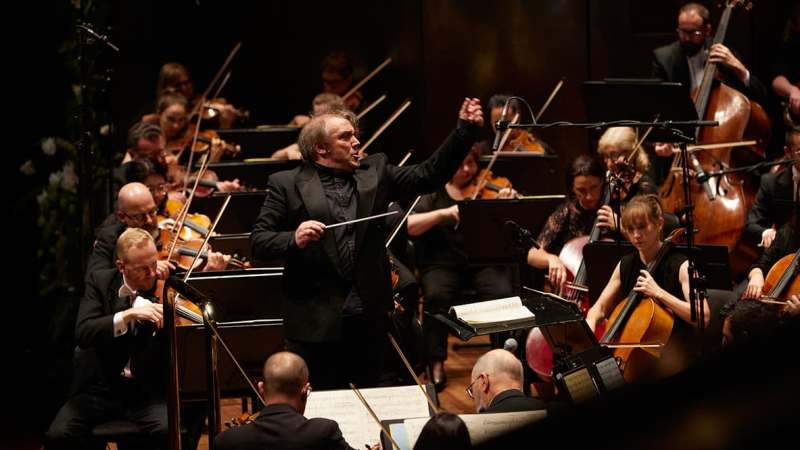
Jaime Martin's reading of this work is superb. Allowing the trumpets and trombones to dominate the sound world of the first two movements cast them both as about war, which is of course abuse on a big scale. From the solo trumpet which opens the funeral march, menacingly played by Owen Morris, to the "rage, rage against the dying of the light" of the second movement, Martin led us unflinchingly through scenes of horror.
The third movement is a horn concerto interspersed with folk dances. For this, Nicolas Fleury stood up at the back of the orchestra, looking for all the world like the trumpeter in Paramount Pictures, especially when in obedience to Mahler's instructions he lifted his horn to shoulder height. The movement also contains fantastic solos for all four principal woodwind players, all of them exceptional. Jaime Martin danced in the dances, as if he were the musician playing Augustin not Mahler hearing it, and made the contrasts in this most heterogeneous movement so interesting that not for one moment did I feel the movement was too long (which I confess I usually do).
Ah, the adagietto! So sonorous is it in Mahler's regret for past loves as well as his yearning for Alma Werfel, who soon became his wife, that one could be forgiven for thinking the entire orchestra was playing, and not just the strings and harp. This music is inevitably coloured for modern audiences by the oppresive melancholy of Thomas Mann in Death in Venice, so it is hard for us to hear it for what it was: a love letter.
Much of the last movement sounds like half a dozen Mahlers all talking at once, but Martin controlled the peroration with a sense of inevitability that, breathless as it was, convinced the audience that the world which Mahler said his symphonies should contain had at least some coherence.
Melburnians will have the opportunity of hearing this team again next Thursday and Friday, when Siobhan will harness her golden voice to Debussy's Ariettes Oubliées, in Brett Dean's instrumentation. I would be there myself but for my plans to be in Bali.
Event details
Melbourne Symphony Orchestra presents
Zenith of Life
Conductor Jaime Martín
Venue: Hamer Hall | Arts Centre Melbourne VIC
Dates: 24 – 25 February 2023
Tickets: $121 – $69
Bookings: www.mso.com.au